Loading preview...

Reach out to us for any inquiries or support.

We’re here to help you with all your needs.

Get in touch with our team anytime.
How We Help
Why Venveo
Resources


Venveo is an award-winning digital marketing solutions provider. Since 2003.
©2026 Venveo

Beth PopNikolov
CEO, Venveo

In manufacturing, the difference between thriving and stagnating often comes down to one crucial factor: quality leads.
And while it often takes a custom approach to generate leads for a particular manufacturing business, working with dozens of manufacturing brands has helped us identify efficient techniques that have proven themselves repeatedly.
This article presents 23 of the best lead generation tactics for manufacturing businesses, organized into an easy-to-follow framework.
Whether you're looking to expand your customer base, enter new markets, or optimize your current lead generation efforts, this guide provides practical solutions to help you achieve your goals and drive your manufacturing business forward.
Generate more leads and gain a competitive advantage with our bespoke strategies. Contact us today to learn how we can drive your manufacturing business forward.
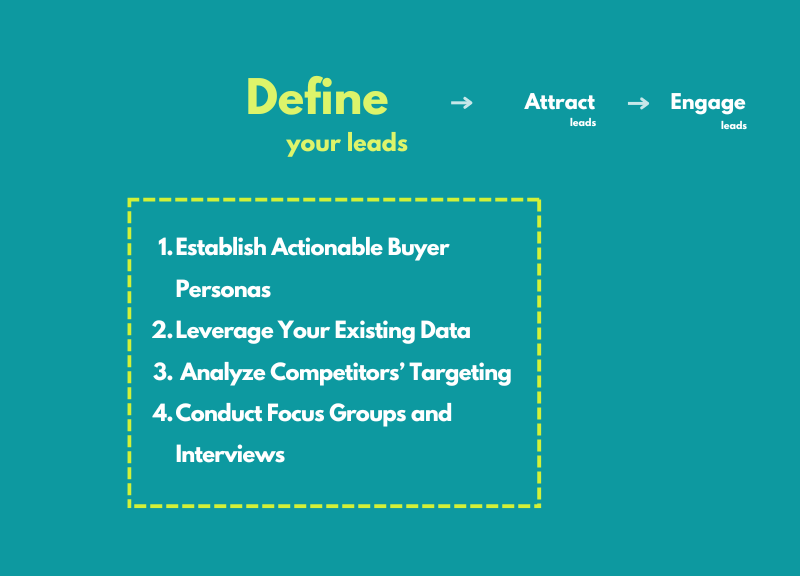
Lead generation for manufacturing companies is a complex, multi-step process that boils down to three main stages:
1. defining what a lead is for your specific manufacturing business,
2. attracting leads with high potential for conversion, and
3. engaging leads into your sales funnel.

Each stage of the lead generation process is crucial and interconnected: define your leads vaguely, and you won't know where and how to attract high-value manufacturing prospects.
And even when you define your leads well, you still need to use this knowledge properly to attract high-value traffic to your manufacturing website and then convert visitors into sales-qualified leads.
Simple in theory, but obviously every manufacturing company is unique: a local brick manufacturer’s lead definition will differ from a global construction materials brand, impacting the entire marketing funnel.
But despite these differences, the framework applies: define- attract - engage.
Let's start with properly defining leads for your manufacturing company.
We've seen manufacturing companies waste thousands of dollars trying to engage the wrong audience that never converted.
The reason? Their definition of a lead was vague or non-existent. They cast a wide net, hoping someone would stick around.
This approach might work for global e-commerce giants like Amazon or Walmart, but for most manufacturing companies, it's a waste. Your leads are scarce and your target audience is much more specific.
The better you define a lead for your manufacturing company, the more efficiently you'll engage prospects and convert them into customers.
The following sections will help you properly define your target audience and use that knowledge to generate better leads for your manufacturing business.
Your definition of a lead plays a pivotal role in how effective you are at generating leads.
Actionable, well-defined lead profiles:
Below are examples of actionable lead profiles for a construction materials manufacturer who wants to grow the number of partnerships with architectural agencies:

Compare these two personas. Both are profiles of architects, yet they are so different. Both personas will give you a clear understanding of which platforms should be used to attract them and what pain points your lead magnets (blog posts, email newsletters) can address to capture their attention.
For example, to attract the first type of customer, you might need to create a webinar focused on how financially efficient your manufacturing product is in large-scale projects. In contrast, to attract another type of lead, you might need to develop a series of social media videos where your product is shown in a more creative context.
You can and should establish several personas, especially in B2B sales where personas can be very different, ranging from distributors and corporate CEOs to senior stakeholders and business owners.
The following sections will help you establish more actionable buyer personas.
Recommended read: Mastering Market Research for Manufacturers: Product to Strategy
To establish detailed, actionable buyer personas, you don’t need to order costly research or spend hours forming and analyzing focus groups.
A great starting point for many manufacturing businesses, especially those that already have some digital presence, is mining existing data. Below are a few examples.
Google Search Console and Google Analytics are primarily used for traffic analysis but also contain valuable data about your audience's behavior. You can track which countries people are visiting your website from or see which articles people spend the most time reading.
Advanced Google Analytics users can track how many articles an average website visitor reads per session and what links they click when first visiting your website.
Every major social media platform has built-in analytics that you can use to better understand your audience. Instagram and YouTube contain valuable data on demographics such as age, gender, location, language, and even interests.
Study this data to better understand your audience and use that knowledge to enrich your buyer personas.
If you already have an email newsletter, analyze open rates and click-through rates to see the most engaging titles and newsletters. Compare this data against your buyer personas to better understand what they find valuable or what causes them to unsubscribe.
CRM systems are a wealth of customer data – depending on how robust your CRM integration is, you can analyze the entire sales funnel from the first communication to a finished sale and extract this data to build buyer profiles.
If you don’t have a CRM, don’t worry – you can always start using one or use other data channels at this stage.
Tools such as BrandWatch, SparkToro, or YouScan help you track when your brand is mentioned on social media and in what context. But you can also use them to see who is mentioning your manufacturing brand – real people with real stories. Use this information to enrich your buyer personas.
Your brand will likely have reviews online, be it Google Reviews, Yelp reviews, or third-party review aggregators such as Clutch or G2.
Customer reviews contain a wealth of data that you can use to establish or improve your customer profiles.
Sometimes the fastest way to update your buyer personas is to analyze your competitors from that angle.
Here are a few places to gain useful information:
Use this new knowledge for two purposes: enrich your buyer personas and identify gaps in competitors’ marketing – if their targeting is all over the place, there may be opportunities for you to fill those gaps effectively.
To further refine your personas, you can invest in focus groups and one-on-one interviews.
It’s best to conduct interviews after you’ve done your research through other channels to refine your personas rather than create them from scratch.
Otherwise, qualitative insights gathered when interacting with a limited number of people might lead to bias in your perception.
Interviews are great opportunities to get feedback you would not get anywhere else, such as unique pain points, in-depth product experience, communication preferences, or comparisons with competitors, e.g., how consumers perceive your manufacturing brand compared to competitors.
After you’ve defined your target audience, you can start attracting leads to your manufacturing website and other digital assets.
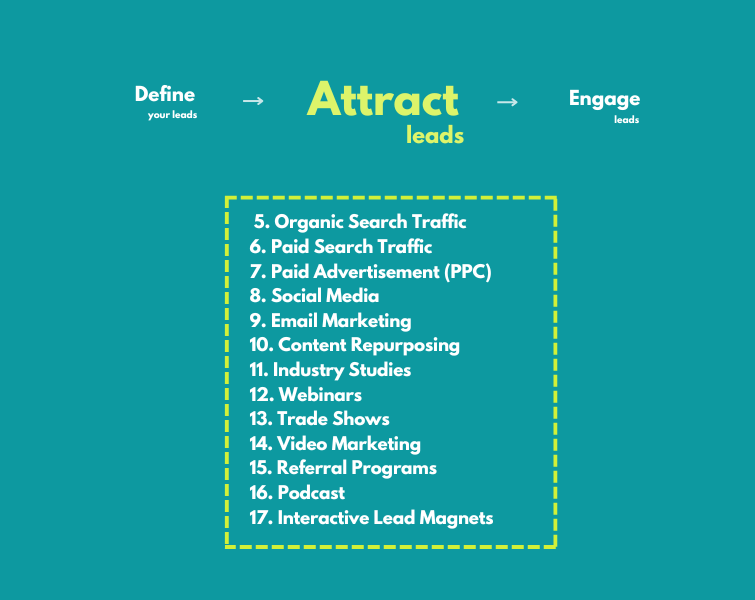
The next few sections will outline the most efficient strategies you can implement for attracting industrial leads with high conversion potential.
SEO, or search engine optimization, is the process of creating and optimizing pages of your manufacturing website so that they rank high for specific search queries and hence attract traffic from popular search engines such as Google.
You can rank blog posts, landing pages, and even product and service pages, but the main challenge here is ranking for the right keywords.
Organic traffic from search engines, despite growing competition, is still one of the best ways to ensure a stable stream of manufacturing leads with high conversion potential.
Advantages of attracting manufacturing leads through organic traffic include:
If you have developed customer profiles, you already know what type of content your prospects want to read and what kind of information they are likely to search for using Google or other search engines.
Additionally, insights you get from search traffic analysis can be used to improve performance in other marketing channels or platforms. For example, if you notice growing traffic for blog articles about specific technology in your industry, such as AI or augmented reality, there’s a correlation that videos and social media posts produced around these topics will generate more engagement as well.
Another example would be optimizing product descriptions for search performance in distributor’s search engines, e.g. to ensure your product appears more often in Home Depot or Amazon online searches.
Picking keywords that your manufacturing brand will benefit from the most, developing content around topics that you can rank for, and properly scaling your SEO campaigns is a complicated topic. If you’re interested in learning more, you can read our detailed guide, SEO for Manufacturing Companies: Strategies that Drive Results
Paid search refers to buying ad placements directly in popular search engines, mainly Google.
Paid search advertisements are the quickest way to get a stream of leads to your manufacturing website, but successful paid search campaigns don’t exist in a vacuum – they require constant evaluation of your entire sales funnel.
Are you A/B testing different titles, ad copy, and landing page designs to see what resonates best with your audience?
Ensure your keywords are highly relevant to your products and industry. Use negative keywords to filter out irrelevant traffic and save on ad spend. Monitor and adjust your bids regularly to maintain competitiveness without overspending. Track conversions closely to understand which ads are driving not just clicks, but actual sales. Continuously refine your targeting to reach the most relevant prospects and analyze the performance data to identify and replicate successful strategies across other campaigns.
To learn more about paid search as lead generation channel for manufacturers, read Targeting With Online Ads: A Manufacturer's Definitive Guide
Paid advertising in manufacturing involves leveraging a range of ad placements beyond search engines, including display ads, social media ads, and video ads.
This strategy targets specific demographics, interests, and behaviors relevant to the industry. Formats like banners, videos, and carousel ads allow manufacturers to showcase their products' unique features effectively.
Paid advertising captures both passive and active interest, reaching potential clients who fit the target profile. Utilizing platforms such as Google Display Network, Facebook, LinkedIn, and YouTube ensures broad visibility. Key performance metrics include impressions, engagement, video views, and ROI, providing valuable insights for campaign optimization.
Always develop paid ad campaigns in accordance with your buyer personas' pain points. For example, highlight technical specifications and real-world applications in your ads to attract industry professionals, or emphasize ease of use and project ideas to attract DIY enthusiasts.
If you want to maximize the performance of a specific paid advertisement campaign, analyze it from three different angles:
Generating industrial leads on social media offers many advantages to manufacturers, including access to unique audience insights, deeper connections with prospects, exponential growth, and a short feedback loop.
There are several ways to grow your social media channels, and each social media platform requires a specific approach: copy-pasting the same content across all social media channels results in low engagement and stagnant growth.
Always base your social media lead generation strategy on your target audience profiles.
Below are the main ways to generate leads and grow your social media presence as a manufacturer:
When growing social media channels, focus on solid engagement metrics and learn to ignore vanity metrics. For example, views on small YouTube channels are not as important as average viewing time. LinkediIn connections are not as important as LinkedIn post impressions.
Let’s say you created a video showcasing your manufacturing product in use. The 5-minute-long video was viewed 100 times, but upon closer look, most viewers left after the first 30 seconds. Even though YouTube considers 30 seconds of watch time as a view, 95% of people left without finishing your video. You need to analyze what made them lose interest.
Social media advertisement is as effective as other digital forms of advertisement, but you need to be more creative with social media ads as they often compete with organic and more engaging social media content.
Another thing that can affect your social media ads' performance is whether you’re directing people to your website or a social media group on the same platform. Often it’s more effective to use ads to grow your social media groups rather than trying to convert people into customers off the bat.
Yes, viral traffic can be preplanned. Yes, even manufacturing brands can go viral. Even the most boring product can go viral. A good example would be Dollar Shave Club – is there anything more boring than shaving? And yet their funny YouTube video attracted millions of views and showcased the product.
Pro tip: social media analytics tools such as BuzzSumo can be used to see what content goes viral in your manufacturing niche or niches that target similar audiences as yours.
To learn more about using social media as a lead generation asset for manufacturers, feel free to read A Complete Guide to Social Media for Manufacturing Companies
One of the benefits of email marketing for manufacturers is that you completely own your data and don’t depend on third parties. A social media platform can go out of business, but your email list stays with you.
So the goal is simply to build a valuable newsletter that will appeal to your target audience.
For new industrial leads, you can use email as a means of educating and nurturing readers.
For fresh buyers or sales qualified leads, you can use automated drip campaigns to ensure they feel supported and happy with their purchase.
For past customers, you can employ newsletters and promotional emails to keep them engaged and increase the likelihood of a future order.
Before emailing anyone, make sure you’re adhering to the anti-spam laws and following all the right protocols (like an obvious unsubscribe button and including your company name and address in the footer).
To ensure the success of your campaigns, take the time to optimize your subject lines and make your content top-notch by always offering something exclusive to your subscribers instead of simply linking to your latest content. For instance, if you have a list for DIYers, you can include a unique project idea in each email.

With so many different lead generation channels a manufacturer can employ, the natural question is: where do you find the time, money, and energy to create unique content for each channel?
The answer is simple: you shouldn’t.
It's much more efficient to focus on producing one great piece of content and then spend time repurposing it for other channels.
The goal here is not to copy-paste content but to use different platforms to present your data in new and engaging ways.
Let’s say you conducted a well-researched webinar about trends in your manufacturing niche.
You can:
Conducting a study or research in your manufacturing industry yields many positive outcomes:
To achieve the best results, your manufacturing study should be:
Webinars are typically an hour or more in length, and they feature a knowledgeable speaker, like someone at your company, who is able to walk the audience through a specific solution or topic with authority. Webinars can be hosted live or recorded and replayed endlessly, either on-demand or at scheduled intervals.
A webinar can be educational, promotional or demonstrative in nature, allowing you to engage prospects in various stages of the journey. If you always have a webinar lined up (whether it’s new or previously recorded), you can easily capture leads on your landing pages by getting them to enter their email for access, whether or not they choose to actually attend.
Like other videos, you can also repurpose webinars into other forms of content. For instance, the Department of Energy repurposed its webinar on innovative building materials into an article. Meanwhile, the Environmental Protection Agency turned its webinar on AIS construction materials into a PDF.
While webinars aren’t always evergreen in nature, especially if you’re covering industry trends, finding ways to repurpose the materials into various formats will help you get the most out of your content investments. Plus, it can help you drive more traffic to your landing pages than video content alone given the SEO benefits.
A shift in consumer behavior urges many manufacturers to adopt video marketing as a way to connect with younger audiences. For example, a study from Adobe showed that a growing number of Gen Z consumers use TikTok, not Google, to search for information.
Video marketing has always been a great way to generate leads for manufacturing brands due to high ROI, enhanced brand connection, and the ability to convey complex information quickly.
There are many ways to generate leads through video marketing, including:
Word-of-mouth marketing is known to be highly effective, both in terms of cost and success rate. If you can get an already happy customer to talk about your business with others, you’re bound to see results. However, you may need to incentivize word-of-mouth marketing with a referral program.
By giving your customers and partners an incentive to refer new customers to you, you can reach new corners of the market that you haven’t been able to tap into using any other method. Plus, the instant trust that a referral builds in the prospect’s mind helps strengthen your brand, even if they don’t buy any time soon.
The structure of your referral program should be tailored to the type of leads you want to attract. For example, in B2C scenarios, gift cards and coupons can effectively attract end customers. In contrast, affiliate partnerships are more likely to attract other businesses into long-term partnerships with your brand.
Regularly track the performance of your referral program. Monitor metrics such as the number of referrals, conversion rates, and the ROI of the program. Based on performance data, adjust your incentives and marketing strategies to maximize participation and effectiveness. Test different incentives to see which ones drive the most referrals.
There are close to 500 million podcast listeners in the world, so a large portion of your target audience is likely to listen to podcasts as well.
Better yet, the sheer number of podcasting shows allows you to reach a very specific audience of listeners as there are podcasts for architects, interior designers, engineers, construction companies, builders, and more.
The format of podcasts, long and story-driven, allows you to build a strong rapport even with someone who is learning about your brand for the first time if you put in some effort.
At some point, you might even start your own podcast show to build an audience and network with professionals in your manufacturing industry.
Here is some advice for connecting with your target audience as a manufacturer representative on podcast shows:
Calculators, quizzes and configurators can help you engage prospects during the consideration and decision phases while offering something of serious value that can earn links with ease. For instance, providing an easy tool that helps designers calculate the total square footage of a material they need could prove immensely valuable.
Aside from engaging prospects already in your CRM, these tools can also generate leads. When someone arrives on your page to calculate the price of the materials they need, for instance, you can have them enter their email address to receive an instant quote via email and then have a sales rep follow up with them later.
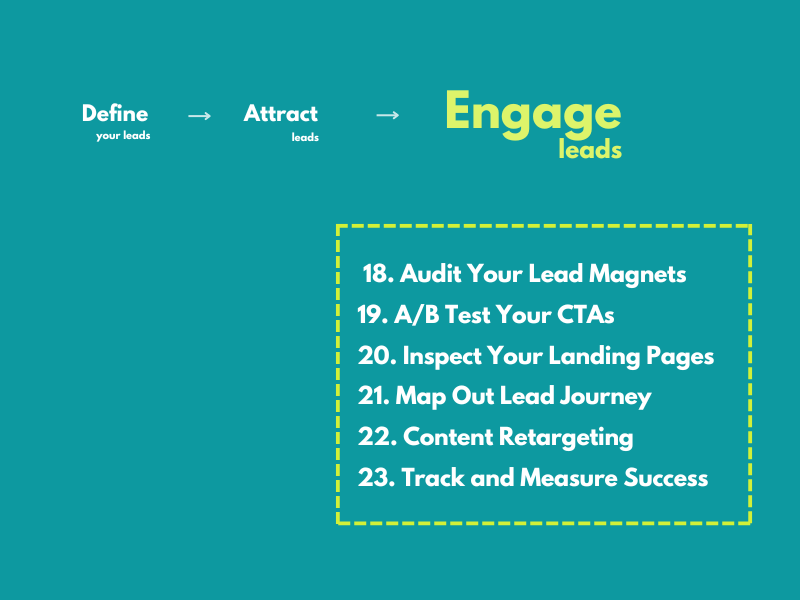
Lead magnets are valuable assets that manufacturers use to capture contact information from prospects. In exchange for access to these resources, prospects typically provide their email addresses, phone numbers, or social media handles.
Effective lead magnets are accompanied by compelling calls-to-action (CTAs) that encourage prospects to take the next step, such as downloading an ebook, signing up for a webinar, or requesting a product sample.
Below are common examples of lead magnets that manufacturers can use in their marketing funnels:
To achieve best performance, make a habit of regularly analyzing and A/B testing of your CTAs in combination with lead magnets and cross-analyze this data with your buyer personas and traffic sources.
For example, a lead attracted from social media viral posts will more likely be engaged via quiz, whereas someone who found your blog after researching industry trends will more likely try to find additional information via your whitepapers and case studies.
Many manufacturing leads are lost due to underperforming website conversion points. For example, call-to-action (CTA) buttons may not be compelling enough or, even worse, may go unnoticed entirely. And yet, we are using CTAs everywhere: to convince blog readers to become newsletter subscribers, landing page visitors to fill ocontact forms, and website visitors to download the latest industry report.
To make sure your manufacturing website is effective at converting visitors into leads, follow this 4-step process: Identify - Create - Measure - Optimize
To learn more about A/B testing for manufacturers, feel free to read A/B Testing: How to Improve Conversions & Customer Insights
For manufacturers, optimizing landing pages is crucial to converting traffic into leads. Here are key techniques to inspect and improve your landing pages.
Essentially, even a single product or service page should be considered as a landing page in terms of how well it converts a visitor into your lead.
Here are key techniques to inspect and improve manufacturing landing pages:
A great way to capture more leads is to better understand your entire leads journey and your role in it.
Here’s a simplified lead generation journey:
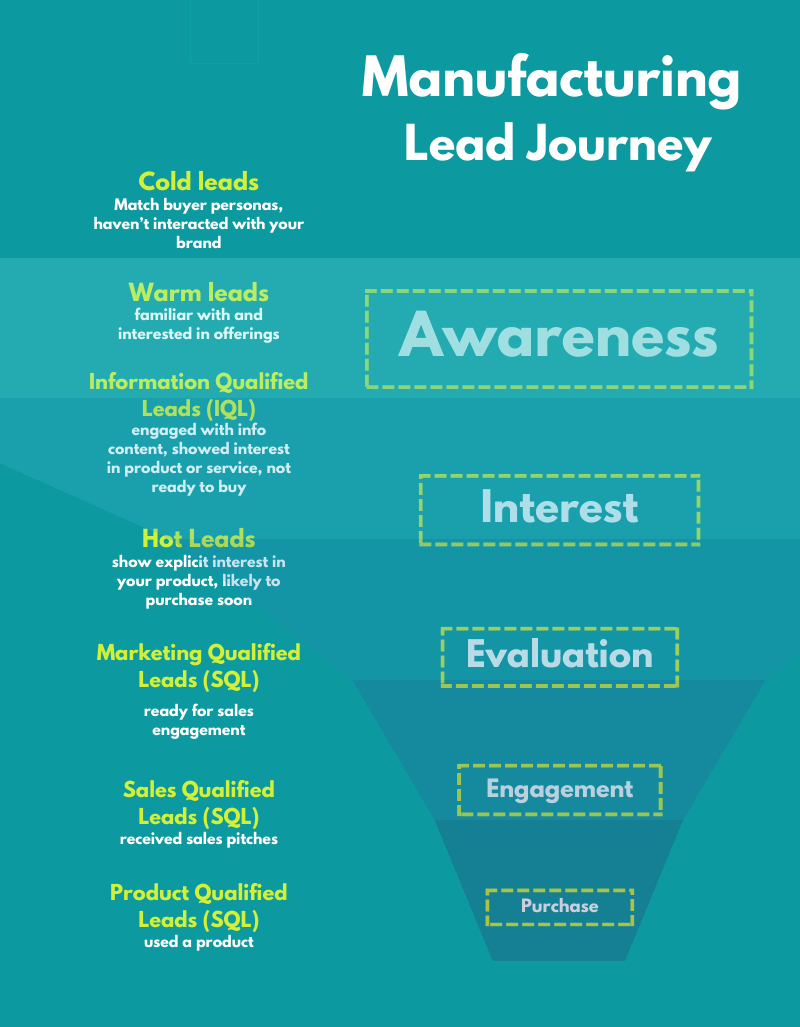
As you see, it takes several stages for a manufacturing lead to progress from being aware about your company and its offering to making a purchase.
That means that no matter how many CTAs and promotions you’ll put in front of a cold lead that never interacted with your company before, they will always convert very poorly. Your sales team need to be prepared to work with digital leads.
Evaluate your marketing funnels from that perspective and you will understand how to properly nurture leads and improve your lead generation efforts. It's also a great idea to regularly inspect your sales enablement environment.
Retargeting is a great example of nurturing manufacturer leads.
As you learned from the previous section, you won’t be able to effectively convert leads who are interacting with your manufacturing brand for the first time.
A good example is your manufacturing blog. Most people who find it through Google search or partner guest post are likely interacting with your content for the first time. Bad news is, 87% to 94% of them will leave as soon as they finish reading one article.
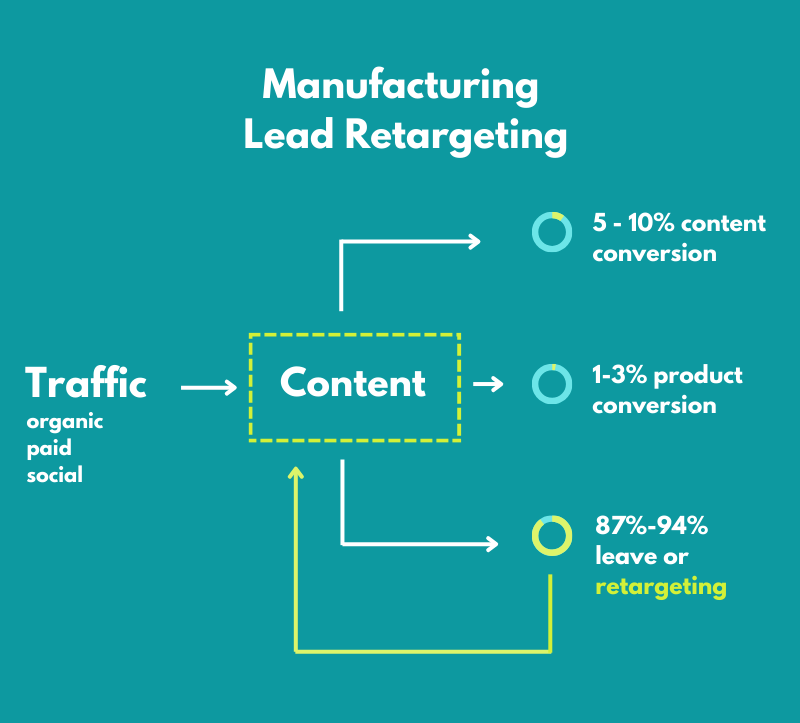
In that case, retargeting becomes crucial. Your goal is to connect this piece of content with other pieces of content that will likely gauge their interest.
Here’s a real world example: a company posted a series of blog posts about sustainable manufacturing that ranks for keywords such as “sustainable manufacturing trends”, “green technologies in XYZ industry”, and so on.
These blog posts attract a steady amount of visitors every month, but they convert poorly on their own. To take it to the next level, these articles, through internal linking, connect with case studies of how their specific brand was able to reduce their carbon footprint through quality control and manufacturing automation. In turn, case studies include lead magnets that, in exchange for using email addresses, allow downloading the webinar recording for that specific topic.
As a result, a user who finds their content through search, interacts with 3 pieces of content instead of 1 before the first conversion attempt, which significantly increases the number of conversions from these guides.
Good news is that retargeting can be implemented for any manufacturing lead generation funnel to boost your conversion metrics if you properly map and analyze your lead journey.
In manufacturing lead generation, tracking success is not just an option—it's a necessity. Without tracking, you're essentially shooting in the dark, unable to distinguish effective strategies from ineffective ones. Systematic tracking allows you to quickly eliminate inefficient approaches, refine underperforming ones, and scale up the best-performing tactics.
Always find opportunities to gain more data about your lead generation funnel and combine that data to gain unique insights:
Use data to enhance your buyer personas and your understanding of lead journeys. The best way to do that is monthly lead generation reporting supplied with links to buyer personas and any changes made to them.
Here's a detailed lead generation framework that you can use for increasing the number of leads that you generate for your manufacturing business:

As you can see, mastering lead generation for manufacturing companies requires a multifaceted approach, from SEO and video marketing to retargeting and data-driven insights.
By implementing these strategies and continuously refining them based on performance metrics, you can significantly enhance your lead generation efforts.
If you're looking to take your lead generation to the next level, our specialized digital marketing services for manufacturers are designed to provide you with tailored solutions and expert guidance. Contact us today to learn how we can help you drive sustainable growth and achieve your business goals.