Loading preview...

Start a project
Reach out to us for any inquiries or support.

Contact
We’re here to help you with all your needs.

Call Us
Get in touch with our team anytime.
How We Help
Why Venveo
Resources
Get weekly data — and insights.


Venveo is an award-winning digital marketing solutions provider. Since 2003.
©2026 Venveo

Beth PopNikolov
CEO, Venveo

Utilizing online tools for various aspects of your business is typically the easiest and most convenient way to reach different audiences. Now is a great time to get into eCommerce if you aren’t already, as 2.14 billion people globally are purchasing products online and using online purchasing platforms more readily. Plus, with COVID-19 having changed the way your customers research and purchase building materials, people are continuing to embrace online shopping.
When it comes to ecommerce platforms, software advancements are constantly being made to keep up with demands and ever-changing technology. With this being said, it can be hard to keep up with which platform is best to use for your building materials business.
We have prepared some basic information you need to know before investing in eCommerce, along with a list of platforms that building material manufacturers should consider if you want to implement ecommerce into your business.
After implementing ecommerce for numerous building materials companies, we’ve learned that the first step for setting up an ecommerce store is to relearn everything you think you know about your products.
Building materials products are often particularly complicated compared to most ecommerce products. Here are some things to consider and review before starting your eCommerce quest:
These questions will drive your platform requirements. If you have any of these special requirements, you absolutely need to talk to a professional and/or representative for each of the ecommerce platforms you investigate. As you continue looking at platform options, you may find yourself needing to make compromises, such as simplifying shipping requirements or revising your SKUs.
Ecommerce is often a feature that is added to an existing website and, more often than not, a CMS will have its own ecommerce solution — like Woocommerce, Craft Commerce, and Drupal Commerce.
At first glance, it may seem like an obvious decision. However, if the average lifespan of a website is between 3-5 years and your ecommerce platform is added a year after your website is launched, the life span of your ecommerce solution will be limited to how long you intend to use the CMS.
The ecommerce platform you choose builds the foundation of your ecommerce website. Every company's needs are unique, and the scope of what features and functionality are required may vary depending on the business.
The cost associated with a platform is often tied to its ease of use and the level of features offered in its user interface. There are many options that can provide a company the tools they need to create an ecommerce solution. However, some may be better suited than others.
Things to look for include:
Customer payment options
In addition, you should keep an eye out for:
Now that you have some ideas of what to look for in an ecommerce platform, let’s take a look at the top-performing ecommerce platforms for you to consider.
Shopify is an ecommerce platform that provides the tooling and hosts your online store. It organizes and displays your store’s layout and appearance through themes. It also provides payment processing, allowing you to accept and receive payment for sold products with support for a wide range of payment options. Shopify is a market leader in ecommerce and is often a great option for both large and smaller stores selling a wide range of products.
Shopify has been gaining market share for the past few years and the data is in line with this reality. Some of the major benefits Shopify offers are their highly considered and intuitive user interface, their scalability and 15 years running with huge community support.
Below, we can see the trends of Shopify and the ecommerce platforms we will discuss later. These trends do not define the quality or usability of any of these platforms; rather, it helps us understand the overall market's perspective, as well as the size of the community around each option.
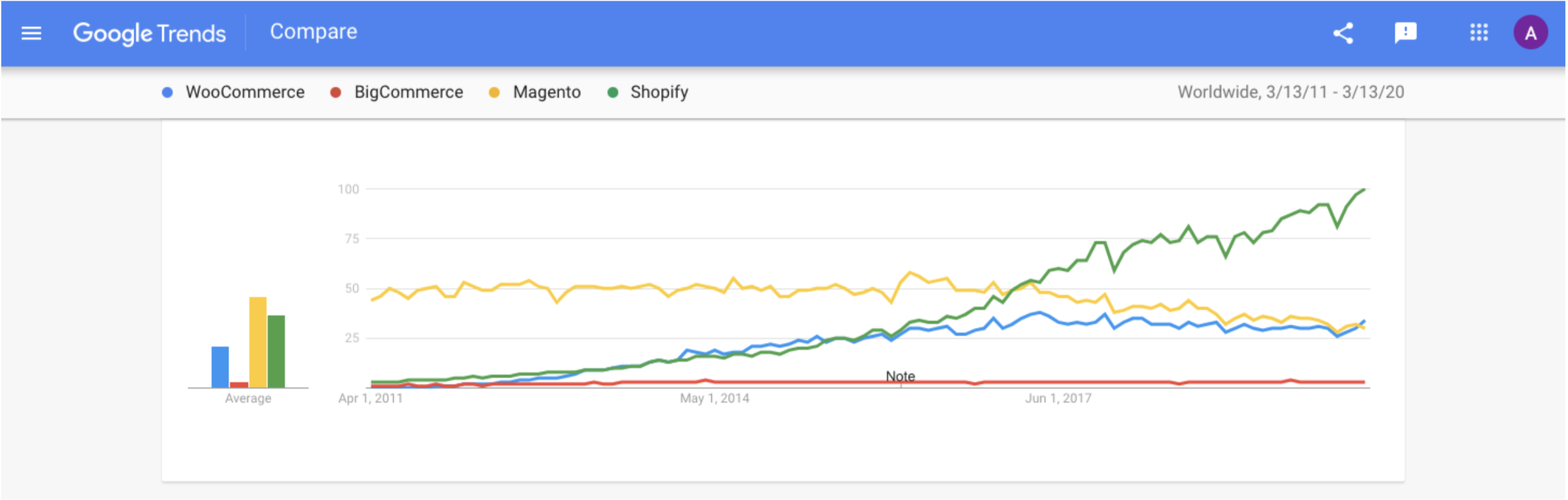
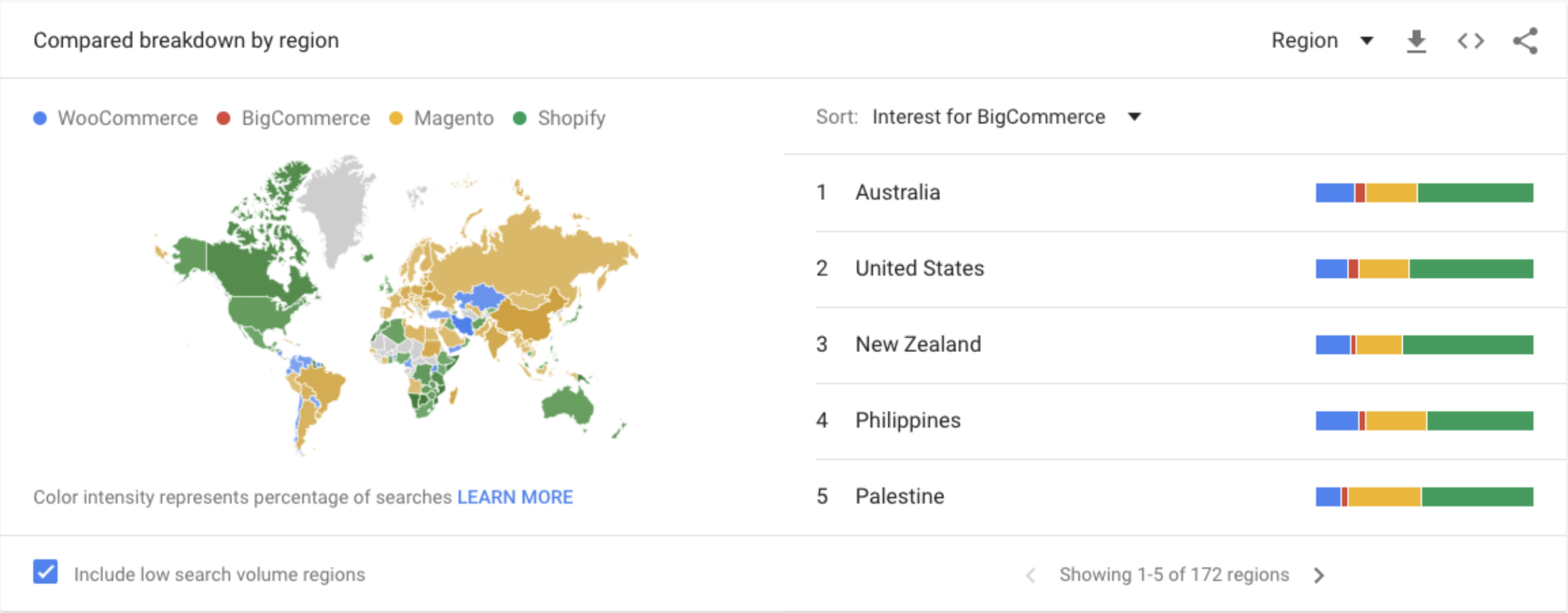
Creating a modern ecommerce experience is becoming increasingly easier. Shopify, based on popularity and user base, seems to have developed solutions that appeal to the largest market. This information can help us determine what solution may be right for your business.
Let’s take a look at the strengths and weaknesses of this platform.
Shopify provides advanced functionality to you with a plugin/application style platform that enables you to download, install and customize the experience. It also is the most feature-rich environment in the current ecommerce space through these extensions. Shopify has built-in options to enhance sales and social media promotion. It also offers both a small business and enterprise-level service to accommodate a wide user base.
Other strengths include:
Although Shopify has plenty of benefits, there are also some weaknesses that are important to note:
Next, we want to take a look at Adobe Commerce which was previously called Magento. Adobe Commerce is an ecommerce platform built on open-source technology that provides online merchants with a flexible shopping cart system, as well as control over the look, content and functionality of their online store. Adobe Commerce offers powerful marketing, search engine optimization and catalog-management tools and is highly customizable.
Being open-source, there is a large community of developer support, and Adobe Commerce is capable of utilizing custom development for use cases not covered by the existing options. Adobe Commerce can use templates or be developed from scratch for businesses looking for ultimate control of their eCommerce infrastructure.
Adobe Commerce provides:
A downside of Adobe Commerce’s themes is that it caters to businesses with large-scale ecommerce requirements and is often too overpowered for what many businesses need. It also has the largest learning curve for companies using the environment and the highest barrier of entry for developer integration and custom development.
All this can result in the time and resources needed to build, maintain and onboard. For this reason, Adobe Commerce can often have the highest associated cost. If you are a small business making your first move into ecommerce, there may be more lightweight and appropriate solutions that can get the job done.
BigCommerce is an ecommerce platform that is ideal for fast-growing stores and companies looking for an out-of-the-box solution for their businesses. It is a popular solution for large-volume sellers and those already dealing with a high number of units or sales.
A user-friendly interface and drag-and-drop functionality make building and integrating ecommerce possible with limited technological resources. BigCommerce integrates with online payment processors like Stripe, PayPal, Braintree and Amazon, and you can also configure your store to take payment by bank transfer, check or money order.
BigCommerce provides:
A downside of BigCommerce’s themes is that it’s in a higher price tier due to its user-friendly interface and lower barrier to entry. BigCommerce’s average theme price is also higher than most of the competitors adding to the overall expense.
WooCommerce is an ecommerce platform that can host your online store. It offers a high level of customization options. It is popular in the WordPress community and offers the majority of support to WordPress integrations. WooCommerce is the most popular platform for building product companies already using WordPress as their CMS.
WooCommerce provides a lower-cost option with a high level of customization. WooCommerce can integrate easily with an existing WordPress backend and has a large extensions and plugins marketplace that is maintained by a robust community of developers.
Other benefits include:
A downside of WooCommerce is that there is a steeper learning curve to implementation and usage for companies. This option may require a higher bar of entry as well as additional time and support for technical issues.
Additionally, other weaknesses are:
Square Online has an ecommerce offering that is suited for businesses that also have a physical store with both physical and online inventory to manage. Square Online offers the tools to track and manage this in one ecosystem, as well as offering payment solutions through physical devices and online payment options. Square may work best for businesses that plan on using the online store as an additional channel, not as their main selling platform.
Square Online Can integrate seamlessly into a physical store's existing inventory. It is ideal for small businesses and those with physical or mobile storefronts. It also offers affordable pricing options for businesses looking to explore ecommerce or just keep overhead to a minimum.
Other strengths include:
When it comes to the downside of Square Online, it is not ideal for larger companies that are not interested in integrating into the square ecosystem.

Now is the perfect time to incorporate ecommerce into your business plan if you haven’t already done so. However, be sure to pick the right platform for your business. It is best to research what will benefit your business the best so you can get the most out of the platform.
If you have any questions regarding ecommerce, feel free to reach out to us at Venveo for any additional information.